
Quick Answer When comparing snap in dentures vs All on 4, a snap in denture (known clinically as a removable implant retained overdenture) is often the better fit for most people who have lost all their teeth. It usually needs fewer implants, clicks out for proper cleaning, can rebuild lost lip and cheek support, and is simpler to repair or adjust over time. All on 4 is fixed in place and feels closer to natural teeth, but it involves more surgery, is harder to keep clean and is more complex to fix if something goes wrong. At Pearce & Co Dentures, we can help weigh up both options based on our mouth, our bone and our priorities.
What Is the Difference Between Snap In Dentures and All on 4?
Both options use dental implants to hold a full set of teeth in place, which is why they are often confused. The key difference is whether we can take the teeth out ourselves.
What are snap in dentures?
Snap in dentures, also called snap on or clip in dentures, are the everyday names for what dental prosthetists call a removable implant retained overdenture. They are all the same thing: a full denture that sits over the gums and clips onto a small number of implants placed in the jaw. Small attachments on top of the implants work a bit like press studs, with matching clips fitted inside the denture. We click it in each morning and unclip it to clean. Our implant retained dentures page explains how these attachments work.
What is All on 4?
All on 4 implant dentures use a full arch bridge screwed onto four implants, which only the clinic can remove. It stays in day and night, and it is cleaned in the mouth, much like natural teeth.
Why Removable Implant Overdentures Are Often the Better Option
For many people, the removable option simply fits real life better. These are the reasons we most often see it come out ahead.
Fewer implants and less surgery
A lower snap in denture can often be held securely with just two implants, while an upper usually needs more. In 2002, an international panel of experts published the McGill consensus statement recommending a two implant lower overdenture as the first choice standard of care for people with no lower teeth. Fewer implants generally means a shorter surgical phase and a lower overall investment, although every case needs to be assessed individually.
Easier, more thorough cleaning
Because a snap in denture comes out, we can brush every surface of it and clean around the implant attachments properly. A fixed All on 4 bridge sits over the gums, so food and plaque can collect underneath and must be cleared with water flossers and special brushes. Good hygiene around implants matters for keeping them healthy long term. Our guide on how to maintain implant retained dentures covers the daily routine.
Better support for the face and lips
After teeth are lost, the jaw ridge slowly shrinks and the lips and cheeks can start to look sunken. A removable overdenture can include a gum coloured flange that we shape to rebuild that support, which can make a noticeable difference to how the face looks. A fixed bridge has less room for this, because it needs to leave space underneath for cleaning.
Simpler repairs and adjustments
If a tooth chips or the fit changes, a removable overdenture can come straight to us for denture repairs, relining or clip replacement, often without disturbing the implants at all. Repairing a fixed All on 4 bridge usually means unscrewing it from the implants, and in some cases a major breakage means remaking the whole arch.
Room to change over time
Our mouths keep changing throughout life. A removable overdenture can be relined, adjusted or replaced as our gums and bone change, while keeping the same implants underneath. It also keeps our options open: in many cases, more implants can be added later if we want even more stability.
When Might All on 4 Still Be the Right Choice?
All on 4 is a well established treatment and suits some people very well. It may be worth considering if we strongly want teeth that never come out, if we find handling a removable denture difficult, or if we want the firmest possible bite. We compare fixed implant teeth with standard dentures in our article on All on 4 vs traditional dentures.
It is also fair to say that snap in dentures have their own trade offs. They are taken out at night, there can be slight movement compared with a fixed bridge, and the nylon clip inserts wear and need replacing from time to time. For most people, these are small, predictable tasks compared with the extra surgery and upkeep of a fixed bridge.
Snap In Dentures vs All on 4 at a Glance
- Number of implants: snap in dentures often need two (lower) or more (upper); All on 4 needs at least four per arch
- Removable at home: snap in dentures, yes; All on 4, no, only the clinic can remove it
- Cleaning: snap in dentures are taken out and brushed; All on 4 is cleaned in the mouth with special tools
- Facial support: snap in dentures can rebuild lip and cheek support with a flange; All on 4 has less room to do this
- Repairs: snap in dentures are usually simpler to repair and reline; All on 4 repairs are more involved
- Feel: All on 4 feels more like natural teeth; snap in dentures are very secure but can move slightly
Frequently Asked Questions
Are snap in dentures better than All on 4?
For many people, yes. Snap in dentures usually need fewer implants, are easier to clean and repair, and can restore facial support. All on 4 may suit people who strongly prefer teeth that never come out. The best choice depends on our bone, health, budget and priorities.
Are snap in dentures the same as implant retained overdentures?
Yes. Snap in, snap on and clip in dentures are everyday names for a removable implant retained overdenture. The denture clips onto implants for stability but can still be taken out at home for cleaning.
Do snap in dentures need to come out at night?
Generally, yes. Taking them out gives our gums a rest and lets us clean the denture and attachments properly. Our article on whether implant retained dentures need to come out at night explains why.
Do snap in dentures help with bone loss?
Implants can help slow bone loss in the areas where they are placed, because they transfer chewing forces into the jaw. We look at this in more detail in do snap in dentures stop bone loss.
Can we convert our existing denture, or an All on 4, into a snap in denture?
Yes. We convert existing dentures to clip on dentures, and that includes an existing All on 4 fixed bridge. If our current denture is in good condition, attachments can be fitted to it once the implants are in place; otherwise, a new denture is made. A denture implant suitability assessment is the first step.
Why Choose Pearce & Co Dentures
Pearce & Co Dentures is a Launceston based denture clinic (formerly Saunders Denture and Mouthguard Clinic) led by David Pearce, a qualified dental prosthetist. We design, handcraft and fit dentures onsite ourselves, so the person making our teeth is the same person fitting them. That matters with implant retained overdentures, where the fit of the denture on its attachments makes all the difference to comfort and security. We see people at 39A Brisbane Street, Launceston, and Ground Floor, 6 Gregory Street, Sandy Bay.
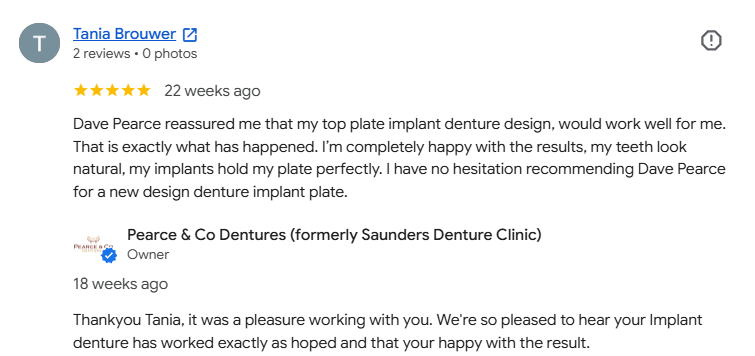
If we are deciding between snap in dentures and All on 4, the clearest next step is a face to face assessment. Book a consultation with our Launceston team.